Monday, October 12, 2009

Binukot


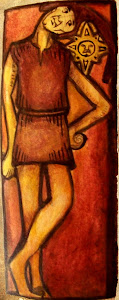
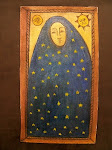
Last year my history 1 professor introduced to us through a documentary film an unusual and interesting tribal story in the rough and remote mountains of Capiz in the Philippines. There is a community there, just like any isolated group of people, with their last binukots, a seventy three year old grandmother named Isiang. Binukots are the princesses chosen by their community as the most beautiful woman in the place. She will stay in a hut, unexposed to sun and any kind of labor. Whenever she gets out, she must cover with a cloth for protection from the outside elements, and she is lying on a hammock attatched to a bamboo pole carried by men or her servants. She never exposed to public, and her husband was chosen by her parents.

She wear a veil so that nobody could see her face, perhaps except to her closest servants. She had the best food in their community. The binukot is also bathed by her servants, and she never allowed to work, even going to school. All she have to do is to memorize by heart their priceless heritage, the hours-long epic song. The ten epic songs is about the history of their tribe and the lineage of the family of binukots, mixed with exaggerated stories and tales that are considered legendary. These epics are the "Tikum Kadlum," "Amburukay," "Balanakon," "Sinagnayan," "Kalampay,"and "Nagbuhis," "Pahagunoy" and "Alayaw".The song is passed only to the binukot, and her successor should also memorize the epic song, and so on.

Since binukots never allowed to do any work, they become frail and weak. During the second world war, where the Japanese occupied the country, their were the first victims since they can't run or probably even walk. Quite sadly, the binukots seemed raped. So after that the family of producing binukots stopped, until it gradually fades. They say that only seven binukots left, and they are all too old now.

The famous binukot, Elena Gardoce died recently at the age of 98. Her daughter and apparent successor Angga, forced to become a binukot to preserve their tradition and the generations-old songs. But Elena's grand daughter Emily refused to take her mother's place. Rather she wanted to become a teacher. It is quite sad to see them gradually fade, especially the remaining seven binukots who know the song by heart.


Picture of the binukot courtesy of flickr.com

And also, thank you, thank you so much for your concern about the typhoon Ondoy. Well, luckily, we live in a nearby hills so the flood didn't reached us, only the heavy rain and wind, and also brownouts. Maybe I should also say sorry because you worried too much about what happen to me (especially the bunny, sorry if I worried you.). Again thank you for your concern.

Friday, October 9, 2009

Comic strips and the Flood

So far I'm working my academics to finish this semester. Among them is this seven page comics for our final plate in advanced illustration class. Each paper is in A3 size, and should be executed in pen and ink. Randomly, a classmate of mine named Piya published her work in a blog, and she called it ingay biswal or visual noise. It was a fascinating comic strip for me, and I really praise her works, especially this one. And here is some of the page of the comics.


You can see the complete story of the comics in this blog. I hope I can also post my comics when I finished it.

Last week, I had a terrible experience, that probably I considered one of the darkest days of my life. The typoon Ondoy hit our country and I was in the library at that time, unaware what was going to happen. When I came out, a terrible rain and wind greeted me, and I hardly get out of the school until I saw the road to home was filled with rushing water. I was trapped between two deadly floods along the way to home. I saw people screaming and panicking, running to a higher ground. Everything was chaotic, from the panicking people and stranded cars to the rushing waters filled with mud and dirt. I also can't stay near the rushing flood beacause I brought the laptop soI also got a higher and place to stay.
I decided to sleep on a train station, along with other stranded people until early morning, when the cars started to move again. And when the sun rises up, we passed by the flooded road now lowered filled with dirt hanging on the cable wires, things like books and tables washed out from the houses there, and cars that turned upside down. And after almost nine dark hours, I finally got home.

Saturday, September 26, 2009

The Wandering Knight


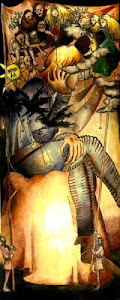
A knight walks under the blue, blue sky. He has traveled over many lands, had lost his horse, and is tired of this long, long walk. But despite this, he, in his shining armor, still wants to finish his ultimate goal. This is a not so recent illustration of mine from my sketchpad. I drew it months ago in watercolor. I want to dedicate this to Alex, who is an old friend of mine. Though sadly, I haven't seen him again since the last time we met about a year ago. I wish him good luck, wherever he is.


Randomly, I placed a dragon and a bird at both sides of the knight. I put them there because I sometimes see Russian icons or Byzantine paintings of portraits,usually mother and child, flanked by figures of angels at their sides.

Friday, September 18, 2009

Of Paintings and Old things


This a small illustration of mine for my eldest sister Joyce of an Angel called Ardarel. As you know, Ardarel is an angel belonged to the Elohim class, and he is known as the Angel of fire. She told me that this is her guardian angel, and she requested me to portray her angel and post to her blog as her picture. So I started looking for angels and I come up with these gothic angels, which always fascinates me every time I see them in Netherlandish paintings or in illuminated manuscripts. So I looked for medieval portraits and depictions of angels, from the most grotesque, bizzare face to the highly realistic ones.

Of course, I look to the most familiar ones, including my favorite artist Jan Van Eyck, which I truly admire his strong handling of colors and details, as well as the faces of her angels and saints. I also saw, again, this painting of Van Eyck of a statue angel. He truly achieve the illusion of the angel, setting as a statue on a flat surface, and somehow, I am recently practicing this illusion, which is quite difficult to. I compiled this pictures into one and you can click it for better viewing.


I also encountered this Gothic sculpture of an angel by an unknown master. The technique used by the master in sculpture is somehow had a resemblance to Tilman Reimenschneider, another favorite artist of mine. The heavy drapery, thick clothing, and Gothic, elongated faces and bodies is their signature and this feature makes them unique and graceful for me.

Bruegel also influenced my angel. He painted this allegorical painting of the fallen angels. His bizzare figures always took me to his world. Somehow, Bruegel's works is another realm to me, and not just a mere interpretation of their beliefs. Every time I see his work I had this feeling that he came to a world far far beyond our countries, and then returned to his home and started to illustrate the world he visited.

Well, weeks and weeks after I finished the angel, I started to have interested to the angel's life. So I researched about him. According to legend, Ardarel was born mortal, with human parents. But soon he transformed into his real form as angel in the age of seventeen and joined other angels. To be honest with you, despite of my interest about celestial creatures, I don't much researched about their specific lives, even I had a story commissioned by a friend about angels and the after world.

Monday, September 14, 2009

Mother


Last time, you saw my pen and ink illustration of my mother's family tree for my second plate in my Advanced Figure Illustration class. For that cause, she gave me the full list of her direct relatives in their clan, including her cousins and the children of her cousins although she didn't know exactly their stories and histories in full detail.

Actually, mother hardly tells much of her stories about her past and her family. All I know is that she is the youngest among the thirteen children of my grand parents, which I never met personally, and that she was the only one who was fortunate enough get into a college. She said that it was because her siblings only wanted to spend their time in the fields, harvesting rice from their vast land.

Later on, fortunately, she gradually told me her past, as well as those of the other members of the family when I asked her about their family tree. I want to compile those stories as one in here, because mother didn't talk about the stories in just one seating (unlike my father who usually does that), and usually she refuses to talk about it too long. Perhaps because she doesn't like storytelling. One of the events that maybe made her tell some of those buried details was the recent wake for my grandmother's sister, who passed away this month. She attended the funeral of the last of the children of my great grand parents, along with her siblings and her cousins, who, according to her, possessed dubious personalities. So I grabbed this opportunity to ask her about them and the funeral.

So, let me start her story.

She was born from very kind and gentle parents, Mercedes and Eulogio, who had set up their own land in our present province, in Tarlac, away from their parents from another town. I think my grand parents hometown was different from their parents, that is, my great grand parents. I recently researched my mother's ancestors through the net and other documents. What I found is that most of my mother's supposed direct ancestors, dating back to the middle of the 19th century, was in the town of Pampanga, a few kilometers away from Tarlac. Though I'm not sure of the full details, this may suggest that my grandparents moved and settle on their own land, since my mother also told me that her grandparents didn't live in Tarlac in the first place.

Back to my mother, she was very special for her parents, as well as to her siblings since she is the youngest amongst the thirteen children. They gave her everything she needed, and, perhaps, also everything that she wanted. And in return, she served her parents and siblings, though not in the rice fields, but household chores and education

.
She had an aunt named Carmela, which she never dared to visit due to the woman's very, very strict and moody behavior. She was this aunt of hers who passed away this month. Her cousin's children, who took charge the funeral, also had a very very unpleasant attitude. So unpleasant that I don't want to talk about them all, but perhaps except for one. Her grand children inherited the same attitude. Her grand children, who have become very successful people, didn't want any children playing around where they were staying, and they even discriminated against their own aunts! So even if I didn't meet them in person, I can feel what mother felt about them as she recounted this. In this illustration though, Carmela's attitude is not related to what she is doing here.


My mother got into high school, and then to college in Baguio, far away from her hometown, where she graduated with honours. She even became teacher in her college after she graduated. Then she met father and they moved to the city, and set up their own land, though she still visits her siblings in Tarlac, where she and father once left my eldest sister Joyce for a while there when my sister was quite young.


Then, her siblings started to have families, except for the unmarried ones like Aunt Rosalinda--who lived in their original house, puffing unfiltered cigarettes while playing solitaire. My uncle Antonio also has no wife and lives with aunt Rosalinda. But most of the time he goes out early in the morning to visit their rice fields and guard them, or, according to him, to hunt birds or small animals in woods with his pump shotgun. But, they are very kind people, and among my aunts and uncles, those two are much closer to me, and perhaps to my siblings also. As you can see, I put a cigarette in my aunt's hands and a gun in my uncle's.


Their farm is a vast one, owned by my grandparents. But, something terrible happened to it. One of their sibling, uncle Aniceto, gradually sold their lands for a very cheap price,and without permission to those who rightfully inherited the lands. Like aunt Carmela, uncle Aniceto is a moody man. They complained about what their brother did, but sadly it was never resolved. And even my mother's share to the land was sold, all of her shares. But mother, who didn't want any trouble, just ignored it. And because she lived with father, she didn't much put attention to the conflict. I put a pouch of silver to signify he his betrayal in selling the major parts of their land secretly.

My mother's sisters and brothers usually have some conflict with one another, from the very tiniest of problems to the larger ones, and usually my mother tries not to meddle in such squabbling. But ironically, during their childhood days, they were kind to each other. Perhaps this is because, now that their parents are dead, no one can solve their problems, which is very sad to think about.

Speaking of family affairs and kinfolks, I am currently working on my thesis about families and clans due next year. Well, I also just recently realized that this is a not such an easy task as I have thought it would be, despite of my interest in the topic.