Showing posts with label acrylic. Show all posts

Saturday, August 9, 2014

How Far to Go to School

The humid summer of August is about to end. And things are getting interesting lately!

Recently I joined a contest for a children's book illustration based on one of the three featured short stories. Luckily, I am one of the honorable mentions on the result of the contest.


It was painted on plywood using acrylic.


The works are relatively small (again) each panel is about 8 x 12 inches so that I could carry them easily and slid into an envelope. And also I am lately working and experimenting my work in a smaller painting as you can see in my previous works here and here.


For the sky I used almost pure Prussian blue. This is the first time I used such color since the brand that I want for Prussian Blue is a bit expensive, and I guess it came out very good! That expensive paint suddenly reminds me of the expensive Lapiz Lazuli or the Ultramarine color of oil painting.

The work was based on Genaro Rojo Cruz' short story entitled "Gaano Ba Kalayo Patungong Paaralan?" (How Far o Go to School?). Unfortunately I only had a Tagalog version of the text so let me summarize them to you.

***
He, the narrator, and his brother were off to bed early so that they can go to school early when he asked how far is the school. He asks if "when they reached the pleasant garden of Aling Perla" but the older brother simply said no its not there yet.


And so the elder brother unravels his everyday long journey to school, where he cross rivers, vast rice fields, and various places.  


But the reality is less fairy tale. I thought about the poor children in our far flung and nearly-isolated provinces who are travelling miles and miles on harsh landscapes and perilous rivers just to attend their daily school.

Photograph by John Weinstein

This poor folks, who are often neglected by our government, are really determine to go to school no matter how hard their travel. Sadly enough, most people I knew take for granted of going to school. You could read John Weinstein's article about the rural education in the Philippines here.

So, I partially dedicated this small pieces of work of mine to them.

Lampara Publishing House offered me to illustrate Genaro's story for them, and so I gladly accepted! But this project will start by mid-September because they offered me another project based on another story which I will talk about to you later. and here's a sneak peak on them.


And for the next work, I will not show this to you yet until the recipient receive them. Its a small painting I made many months ago as part of my experiment with my relatively new color; Prussian blue. Ever since college I am quite interested with this new and foreign acrylic color.

Tuesday, December 10, 2013

Two Paintings


Ibrahim offered his son to God as his sacrifice after He told him so.

And later on the Angel Gabriel went to the scene and told Ibrahim or Abraham in Christian versions, that it was only God's test of loyalty.

And instead they offered a lamb (in some versions, a sheep or a ram). 

***

The Judeo-Christian and Islamic religions share a common patriarch: Abraham or Ibrahim. In similar anecdotes, they tell the story of his devotion to his faith that will serve as an example to later generations.

The anecdotes begin in the same manner: God bids Abraham / Ibrahim to go to the mountains to sacrifice his only son to Him. With a heavy heart, Abraham/Ibrahim leads Isaac (in the Judeo-Christian take) or Ishmael (in the Islamic story) to the sacrificial altar, but--having proven the man's exceptional devotion--God sends an angel to intervene. The boy is released, and a sheep (or lamb or ram) is found nearby and is sacrificed in thanksgiving.


Last October, I was tasked to make a small illustration for Manila Bulletin, a local newspaper, in celebration of the Eid-al-Adha, the Feast of the Sacrifice. It is a sacred day for our Muslim brothers and sisters, based on Ibrahim's story above. It was rather challenging to paint this because I had to do justice to this sacred theme the best I could given my Catholic background, and also because I wanted to make the painting relevant not only in an Islamic sense, but also to other people.

At first I had a vague idea of the theme and its rituals. So, I decided to focus on the origins of this day rather than on the traditions, so that a reader can remember where it all began--a lot of Filipinos are familiar with the parallel Abraham story because the majority are Catholics. I also used this painting to try emulating the techniques of a favorite artist of mine, Jan van Eyck. As you might know from my previous posts, I usually try to adapt a technique or two from my favorite artists for inspiration. Exploring their handling of subject or material sometimes helps develop my output.

I drew some sketches of the composition, along with some of the smaller details (which I'll show it to you if I had courage enough to do so!)


Here are some images of Jan van Eyck's work, which I got from this very useful website called
Closer to Van Eyck: Rediscovering the Ghent Altarpiece
, which features that masterpiece by the brothers Jan and Hubert van Eyck. Whenever I look at these pictures very carefully, the amount and skill in every detail really takes my breath away.


What I really like about his style is his absolute mastery of the details, and in my opinion, he is amongst the pioneers of hyperrealism. Although I don't particularly aim for his degree of hyperrealism, as it is really quite above my present skills, I want to learn how he handles details and colors. I still have so many techniques to learn even after graduating from art school.


I tried to make my painting as accessible as possible for the three religions that shares Abraham as a patriarch, but there is a hint of old Moorish ornamentation. I wonder if you can see the nod to the many religions that sprouted from him in the bush below.

*****


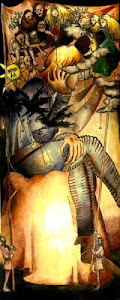
The second painting! One will be on display on December 8th, in a show called "Fornever Friends: An Exhibit of Unlikely Friendships," organized by Ang INK (Ang Ilustrador ng Kabataan, or Illustrators for Children). It's one of my first experiments with painting on wood, done with acrylics. This was also inspired by Jan van Eyck, since I'm pretty obsessed with him at the moment. It's a small work, at 7 x 10 inches, so I had to pay a lot of attention to the small details.


The theme was about opposite characters or subjects striking up odd friendships. For that, I chose a devil and an angel dancing together, holding hands. They're surrounded by other little demons, perhaps wanting to join the dance, or just plain curious about this odd couple.


This would be my second non-academic exhibit.

Here's the poster designed by one of my colleagues. 

*****

We also had the chance to visit our College school, which happens to be the venue of our exhibit. How we really miss this place.


POSTSCRIPT:
You could also visit my work here on Behance! I am still wondering how to sell some of those works.


Wednesday, June 12, 2013

Happy 115th Philippine Independence!


Happy Independence Day! And here's my poster design for the very special day in my country, The Philippines. This is also for the newspaper Manila Bulletin. Design and layout by The Bunny (one of our major work as of now, I think).


(the image is a bit contrasted so that it may not be too dark for a newspaper print)
The text below reads: 
115th Year of Independence
Title: Freedom
Illustrated by: Jericho T. Moral
The featured illustrator is a member of ANG INK was graduated from the University of the Philippines. As of now, he maintains his traditional way of art.

His site can be found here: www.behance.net/jerichomoral.


Done in acrylic on watercolor paper. This one is a bit different painting for me compare to my previous works because of its more graphic, solid-lined figures.


Thursday, September 10, 2009

The Tarot


Last year, the bunny showed to me her set of tarot cards in a green corduroy pouch. The cards were different from the illustrations of the most popular deck,
Rider-Waite tarot deck, illustrated by Pamela Coleman Smith for a mystic Arthur Edward A.E. Waite. Still, when I first saw them personally, I was amazed by their obscure meanings behind the strange gestures and positions of the characters. I am quite interested to their symbolism and meanings, and also in their history. Somehow, their intricate allegorical details of these images still haunt me, leading to curiosity on how did these people manage to create such a bizarre and haunting symbols that are usually difficult to understand in our times, that the meaning behind the symbols of the figures had been almost forgotten, or at least arcane in the passage of time and in view of the various readings and contexts by which the present people are now able to read them with.


They said that Tarot card came from Egypt and brought to Europe about 12th century. But the first known Tarot card created about 13th century in Italy, particularly in Bologna. The Europeans added allegorical figures from the four suit deck, and they are called carte da trionfi or triumph cards. The oldest surviving Tarot card are painted for the Visconti-Sforza family, the rulers of Milan during their time. Later on, in the 18th century,
the cards are filled with some sort of divination or extraordinary powers. Until the cards became not just a mere playing but possessed powers and even can predict the future.

Probably so far, my favorite illustrations of the Tarot were painted by Hieronymous Bosch. They were as eccentric as his other paintings, adding grotesque figures like gnarled monsters. Aside from Bosch, there are also cards painted by one of my favorite Flemish painters, Pieter Bruegel the Elder, wherein he usually featured peasants. There is also cards by Albrecht Durer, and he probably executed this in watercolor. You can look their works
here


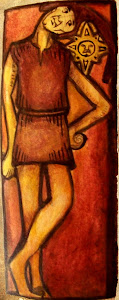
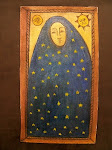
I illustrated my own version of the cards almost three years ago. But I did only two, The Sun and Death. The story behind it is that I had a friend who I knew could read the Tarot cards (Aside from the bunny who also know how to read it). Just for entertainment, I decided to consult her using her cards and her skills in reading it. I remembered some of the cards that appeared and I decided to illustrate two of them.
But I cannot recall now what she said about the meaning of the cards from that reading.