


 Posts
Posts








The humid summer of August is about to end. And things are getting interesting lately!
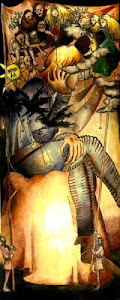
Recently I joined a contest for a children's book illustration based on one of the three featured short stories. Luckily, I am one of the honorable mentions on the result of the contest.


It was painted on plywood using acrylic.


The work was based on Genaro Rojo Cruz' short story entitled "Gaano Ba Kalayo Patungong Paaralan?" (How Far o Go to School?). Unfortunately I only had a Tagalog version of the text so let me summarize them to you.


But the reality is less fairy tale. I thought about the poor children in our far flung and nearly-isolated provinces who are travelling miles and miles on harsh landscapes and perilous rivers just to attend their daily school.

This poor folks, who are often neglected by our government, are really determine to go to school no matter how hard their travel. Sadly enough, most people I knew take for granted of going to school. You could read John Weinstein's article about the rural education in the Philippines here.
So, I partially dedicated this small pieces of work of mine to them.
Lampara Publishing House offered me to illustrate Genaro's story for them, and so I gladly accepted! But this project will start by mid-September because they offered me another project based on another story which I will talk about to you later. and here's a sneak peak on them.


And for the next work, I will not show this to you yet until the recipient receive them. Its a small painting I made many months ago as part of my experiment with my relatively new color; Prussian blue. Ever since college I am quite interested with this new and foreign acrylic color.
Recently I joined a contest for a children's book illustration based on one of the three featured short stories. Luckily, I am one of the honorable mentions on the result of the contest.
It was painted on plywood using acrylic.
The works are relatively small (again) each panel is about 8 x 12 inches so that I could carry them easily and slid into an envelope. And also I am lately working and experimenting my work in a smaller painting as you can see in my previous works here and here.
For the sky I used almost pure Prussian blue. This is the first time I used such color since the brand that I want for Prussian Blue is a bit expensive, and I guess it came out very good! That expensive paint suddenly reminds me of the expensive Lapiz Lazuli or the Ultramarine color of oil painting.
***
He, the narrator, and his brother were off to bed early so that they can go to school early when he asked how far is the school. He asks if "when they reached the pleasant garden of Aling Perla" but the older brother simply said no its not there yet.
And so the elder brother unravels his everyday long journey to school, where he cross rivers, vast rice fields, and various places.
Photograph by John Weinstein
This poor folks, who are often neglected by our government, are really determine to go to school no matter how hard their travel. Sadly enough, most people I knew take for granted of going to school. You could read John Weinstein's article about the rural education in the Philippines here.
So, I partially dedicated this small pieces of work of mine to them.
Lampara Publishing House offered me to illustrate Genaro's story for them, and so I gladly accepted! But this project will start by mid-September because they offered me another project based on another story which I will talk about to you later. and here's a sneak peak on them.
And for the next work, I will not show this to you yet until the recipient receive them. Its a small painting I made many months ago as part of my experiment with my relatively new color; Prussian blue. Ever since college I am quite interested with this new and foreign acrylic color.


