


 Posts
Posts








Panels, as you know, always fascinates me. They are architecturally odd, that sometimes the frames are decorated with architectural motifs, especially when they look like old door-like buildings that swing open and unveiled its wonderful interior of paintings. They are like doors that lead to hidden worlds set in oil paints. The most popular and one of the most wonderful diptychs, triptychs, or polyptych makers are the Flemish during the renaissance. Among them is the famous Ghent Altarpiece by Jan Van Eyck and, supposedly, his brother Hubert Van Eyck, an example of polyptych, a diptych for Jeanne of France by Rogier Van Der Weyden, and The Last Judgment by Hans Memling. Aside from Flemish, the Germans are also good at this, like Matthias Grunewald and Albrecht Durer. My Art History professor showed us byzantine paintings of Madonna and child in a palace-like throne. They also create beautiful triptychs and sometimes in a cross shape.

The Russian icons are also amazing about this. Here is a beautiful example of Madonna and Child by Paolo di Giovanni in about 1300's. Perhaps when I will have enough time I will practice these kind of technique (except maybe that I will have a real gold leaf). You can look for other Russian paneled icons here.
Aside from these classic masters, I also encountered wonderful paneled paintings made by various artists who had beautiful works. One of them is the Russian artist Vladimir Gvozdariki. He had this collage of antique and curious things in a decorated box container that has doors that you can open. You can look his whimsical artworks here.
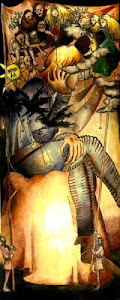
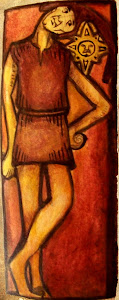
About four years ago I created an unfinished polyptych of my mother’s clan (not the one in Bloodlines) in a cross-shape with six panels. The outer wings have the illustrations of the wives and husbands of my mother and her siblings, facing the family tree. Although I don’t have the plan to finish it, I will create a new one for the bunny’s clan, which I will use for my thesis next year. Though sadly, I do not have any picture of those, but I can post them if I already revise them.


