Posts
Posts







Good day, friends! Okay, give me a second to exhale! For the past few months I had a very succesful, very wonderful, and very memorable time.
First and foremost, I would like to share to you the recent happenings. I just finished last March my thesis presentation about a kinetic diorama depicting a Filipino playwright and revolutionary's, Aurelio Tolentino, famous allegorical symbolic play (or Drama Simbolico) Kahapon, Ngayon at Bukas (Yesterday, Today, and Tomorrow). This was my thesis, as I told to you last time, in completion of the requirements for my Bachelor’s degree in Fine Arts in the University of the Philippines. I went through too many sleepless nights just to complete them, as well as the research writing that accompanied it; my hands became weary from sawing and molding and scavenging suitable old wood from forgotten corners, so were my feet from hurrying about. But all in all, it is quite a relief to see them finished after the tiring effort to construct them.

Last semester I showed you my prototype for the three kinetic dioramas. And last November 2010, I started to execute the three dioramas in wood. They depict the three acts of the play (as performed in 1902), in part of the propaganda effort against the American rule in the Philippines during the early 20thcentury (from 1898 to 1946). And because during those times, nationalistic sentiment were forbidden to be shown in public, especially flaunting the local flag, hence the necessity in using allegorical symbols, fictional characters, dialogues, and scenes.
Let me begin my story with the introduction of the characters.
Dramatis Personae:
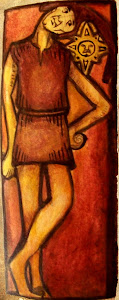
Inangbayan (Mother country) symbolizing the Philippines
Tagailog (River dweller) the hero of the story and Inangbayan’s son
Haringbata (Child king) symbolizing the Chinese Empire
Dahumpalay (Grass snake) symbolizing the native collaborators
Dilatnabulag (Wide eyed blind) symbolizing Spain
Matanglauin (Hawk eyed) the Spanish colonial government
Halimau (Monster) the Friars
Asalhayop (Animal like) another collaborator to the enemies, also one of Tagailog’s sibling
Bagongsibol (Newborn) symbolizing America
Malaynatin (We don’t know) the American colonial government
Masunirin (Obidient) and Ualangtutol (No object) are the loyal siblings of Tagailog.
Curtains up, and the play is about to begin...


Once there was Inangbayan with her son Tagailog, and his siblings. They were under the Chinese king named Haringbata. Tagailog and his loyal people fought for their freedom. They attained momentary liberty when Dilatnabulag and her soldier Matanglauin came, who declared themselves as Tagailog’s allies against their other enemies aside from Haringbata. They became allies and had a ritual of blood compact, as a sign of brotherhood. And the first act ends.
This was the first diorama I created among the three. And since this was the first time I created a diorama with movable images, most of the time I went to the College of Engineering library to consult with books about mechanism and gears. Of course, I also visited Sharmanka’s amazing videos, and the Cabaret mechanical theater for their beautiful automata and mechanisms.
I also went to the Bunny’s brother Hecson, who has background engineering for consultations on my initial draft. The movement is carried out by simple gears.

I started collecting scrap wood (since I want to create my work from found materials) from the Bunny’s house, old plastic and metal cans for gears, sliced portion of metal roofing for the gears’ teeth, and other materials such as epoxy putty.
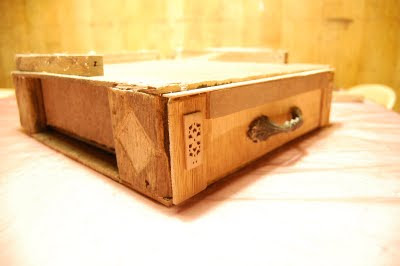
After collecting them I started to construct the drawer or the lower part of the diorama.


Inside the drawer is a small door that leads to the square medallion of portraits of the featured characters. They are also done in acrylic, but of course with great attention since the faces are relatively small to my capacity of painting faces in small scale but with great detail.
As for the lower part, the other scenes were depicted in painted panels just below the diorama.


Using acrylic on board, I painted the lower part of the diorama where the mechanism was placed. The three panels represent the other scenes (from left); Haringbata giving the money bag to Tagailog’s brother and collaborator to the enemy, Asalhayop; the burning of Asalhayop after the discovery of his intention; and the blood compact between Tagailog and their new ally.


I assembled the mechanism before the walls of the lower part. It took me about two weeks to place them correctly since I sometimes loosened the teeth of the gears. And of course, accuracy is essential in the mechanism, and that is what I tried to master during the construction. The gears should be placed correctly.

I also made a small door to view the mechanism inside.

And there, the drawer and the lower panel.

After assembling of the lower panel, I started to mold the major figures in the scene. The climax of the story is the battle between Tagailog and Haringbata with their armies. I also spent almost three days making wire armatures, molding, and coloring the two figures and the relief figures of the army at the backdrop.


I also picked up some small branches in our park for the trees since I don’t like to buy the commercial model (for some reason I just want the imperfectness and grotesqueness of the diorama) and small dried leaves from the Bunny. The dried leaves were from an old potpourri batch, but I used it as leaves of the trees. And they look fine together.

Then I assembled the figures, the painted ground which is in reddish brown for sinister, blood-stained-ground effect.

Then I assembled the backdrop.
******************************


The second act opens with Tagailog’s siblings worshipping Halimau the Friar. He ordered Dahumpalay to arrest Tagailog for insulting Halimau by throwing the bag of money to him as a mock tribute. While he was in prison, Halimau ordered Dahumpalay to kill his own brother. Tagailog knew about this, and he killed him first and escaped from prison. Then he assembled his army to launch an attack against Dilatnabulag. They were astounded when they saw Tagailog since they knew he was dead. But before he attacked Dilatnabulag and her retinue, they buried Inangbayan alive. But Bagongsibol, the new ally, arrives in time and helps Tagailog to crush their enemies. And then Inangbayan rose from her grave in a more glorious manner and appearance. Then they buried the second oppressors. Despite of Tagailog’s doubt about Bagongsibol’s intentions, he accepts their offer of alliance and military assistance.
This was actually the last diorama I executed among the three because it had the easiest mechanism to assemble; also, it is the largest one, measuring up to almost two and a half feet, so I had to focus on its construction.

During the construction of the first and third diorama, I also started to assemble the second diorama's drawer.
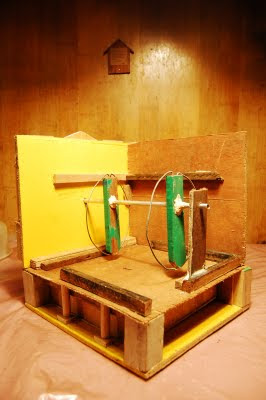
I made the gears almost oblong in shape for the movement of the figure, with which Inangbayan is resurrected from her grave, and the sun rising behind her.


I also later noticed that among the three the second diorama has the most improved and well, molded figures. Probably because it had an easier mechanism, and that I am not so satisfied with the figures of the third diorama.


As for the lower panel, I glazed it with umber for oldish effect.

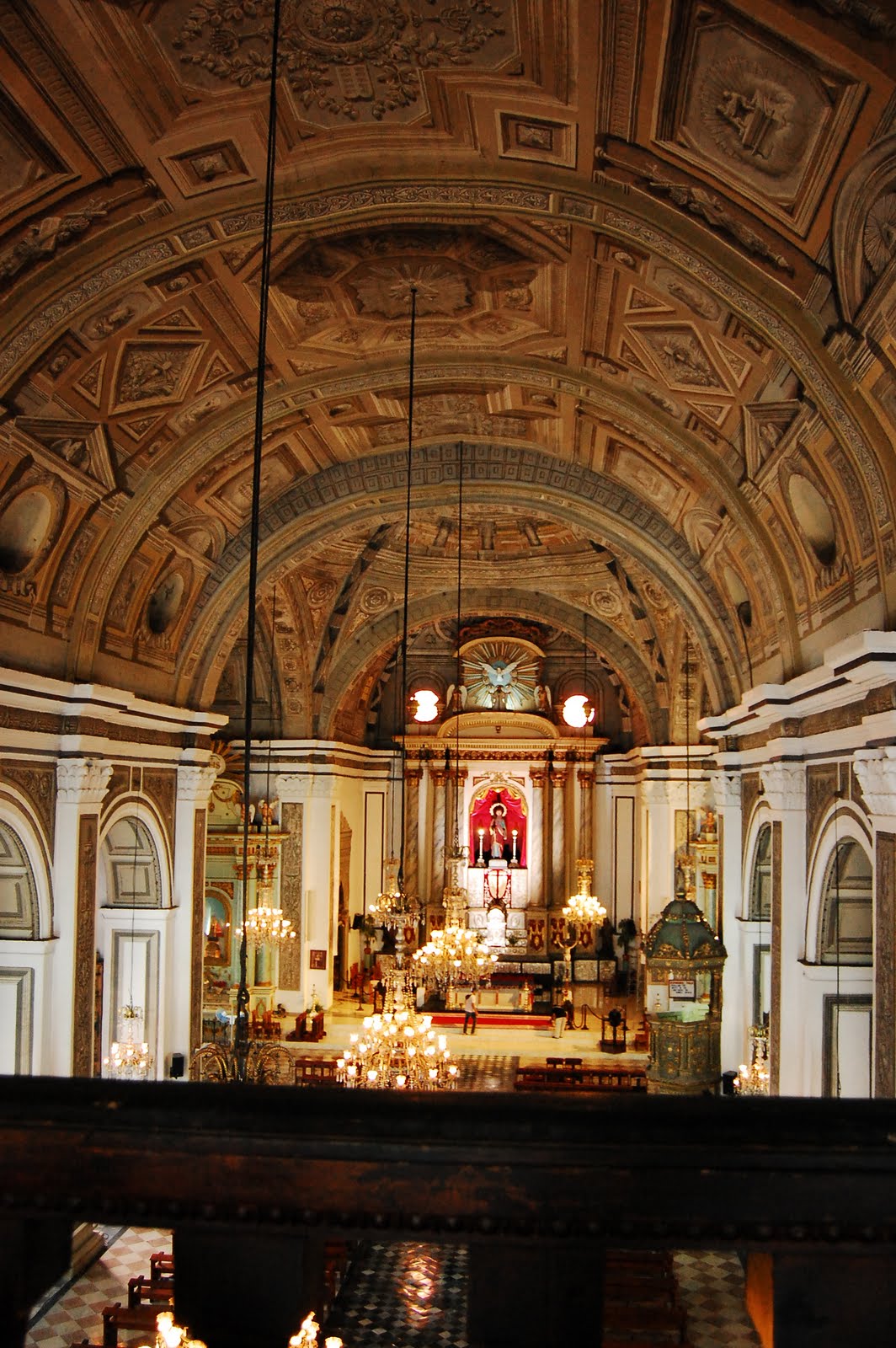
(Photograph by the Bunny, San Agustin Church, Manila, Philippines)
I was inspired by the Spanish Colonial churches in the country for the design in the lower panels. In colonial churches, they had the main altar called Retablos which is a bit similar with the one of medieval altarpieces in Europe, where there were panels with elaborate borders of columns and small pediments, and inside are either reliefs or paintings. The scenes in the panels are; the worship of Halimau the friar, Tagailog’s escape, and the meeting of Inangbayan and their new “ally” Bagongsibol.

Here I work for the painting of the pediment which depicts Kalayaan or Freedom as a tree. The three by the way is Inangbayan's husband, which he saps blood of the past revolutionaries.


I also seized the opportunity of making the building backdrop more detailed since as a child I had an interest in modeling, particularly in buildings and interiors. The setting is a late 19th century Spanish colonial plaza, with the church behind them. But instead of cobblestone floor, I make reddish ground just like the previous diorama.
The sun behind them, which rises at the same time with Inangbayan, is coated with acrylic gold with beads so that it may shimmer a little bit (see the picture below).
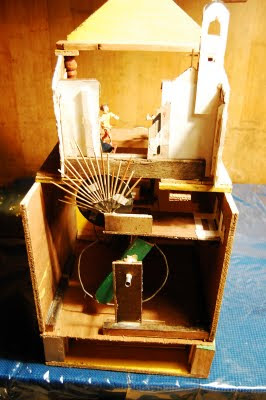

So the mechanism works when Inangbayan rose from below and the sun behind her at the same time.

And yes was me finishng some relief designs there. Taken by my sister Juisy.
***************************************


The third act opens with the sewing of the new flag in preparation for their independence. But Malaynatin refused Tagailog's request for independence, saying they are not ready. Tagailog was very disappointed, and secretly planned to reassemble the army against Bagongsibol. But when Malaynatin was asleep after Tagailog walked away, he has a nightmare of Inangbayan and Tagailog with his army and artillery urging to give them freedom, as well as the ghosts of the past and the King of Death, threatening him to free their mother. When he woke up, he said this to Bagongsibol, but she doesn’t take it seriously. And his dream comes true; Tagailog has his army in hiding, waiting for a signal for attack, if talking to them proves futile. The final moment came, and Inangbayan and Bagongsibol met, and they still refused. But instead of the army, the children of Inangbayan begged to Bagongsibol and Malaynatin, appealing to their mercy. They gained her sympathy and, finally they gained their long awaiting independence.
For me this scene is the most grotesque and out-of-the-reality fantasy since the main diorama depicts Malaynatin’s dream.
Of course, as a lover of grotesque figures in art and architecture I seized the opportunity of unleashing my interest in executing almost deformed unnatural figures.


I depicted the ghosts of the past as almost monstrous figures for a sinister effect. Ever since, I had been fascinated with grotesque figures in art, from the gargoyles of medieval cathedrals in Europe to the paintings of Picasso during his Blue period and German painters who revolved around deformity and unnaturalness.

Among them of course is Hieronymus Bosch, who was my major inspiration for the figures in the third diorama. I also exaggerated their expressions so that fear is heightened. Among the three, the third diorama is the only one which is left open at the back, and the gears are visible from the tableau. I just want to depict their reality, that the dream is a portal between their real world (which is the diorama) and their unreal world (which is the mechanism and our world).

And there they are, posing for a picture! Though, at this point, I haven't applied the Old Oak woodstain for a uniform color of the exteriors.
***************************************
For the very wonderful happenings, after I finished the three dioramas, I passed the nerve-wracking thesis deliberation last March! Right after this, we opened our thesis exhibit held in the Rockwell Powerplant Mall. So to speak, it was exhausting, arranging everything for almost two days. Lacking sleep, we went back and forth from the exhibit venue for the preparation, to my friend Jomar’s house to take a bath, and again to the exhibit. We simply did not even try to think of our transport expenses.
But all in all, it was a successful program.

And that was me with the Bunny during the opening of the exhibit.

And my poster! Together with the reduced scale model of the actual, two-and-a-half feet dioramas.

And here's the poster of the Bunny's thesis. It's a book about Marian Imagery and Iconography in the Philippines.
But of course, after we finished preparing, the opening was wonderful. With visitors taking a look at our theses, for which we gave blood, sweat and tears. For me, it’s all worth it!


People wandering and amusing themselves inside the exhibit.
************************************
And for the very memorable moments, my graduation day! Finally, after five long years, I managed to finish my college studies. Although, of course, surely the Bunny and I will miss the green landscape of the school, the canopy of acacia trees, and the language of the plants and small insects, the murmur of faraway traffic, and the enchanting dance of the fireflies in the evening as well.


We had the candlelight ceremony, which traditionally held during graduation dates back to early 80s. This moment I really felt the school year was now end, and after almost 2 decades of being a student, I am not a student anymore.

And here are my friends who also graduated last April! (from Left; myself, The Bunny, Arvin, and Jomar). Here we wear our traditional costume, called Barong Tagalog, for males. We are also wearing the University's Sablay, worn during graduation by the alumni of our school, instead of the usual toga.